
Income Tax
TDS Sections and Rates: Practical Guide for Common Payments
Understand common TDS sections for salary, interest, contractor, rent, professional fees, commission and property purchase with rates and key cautions.
Last Updated: 22 July 2026
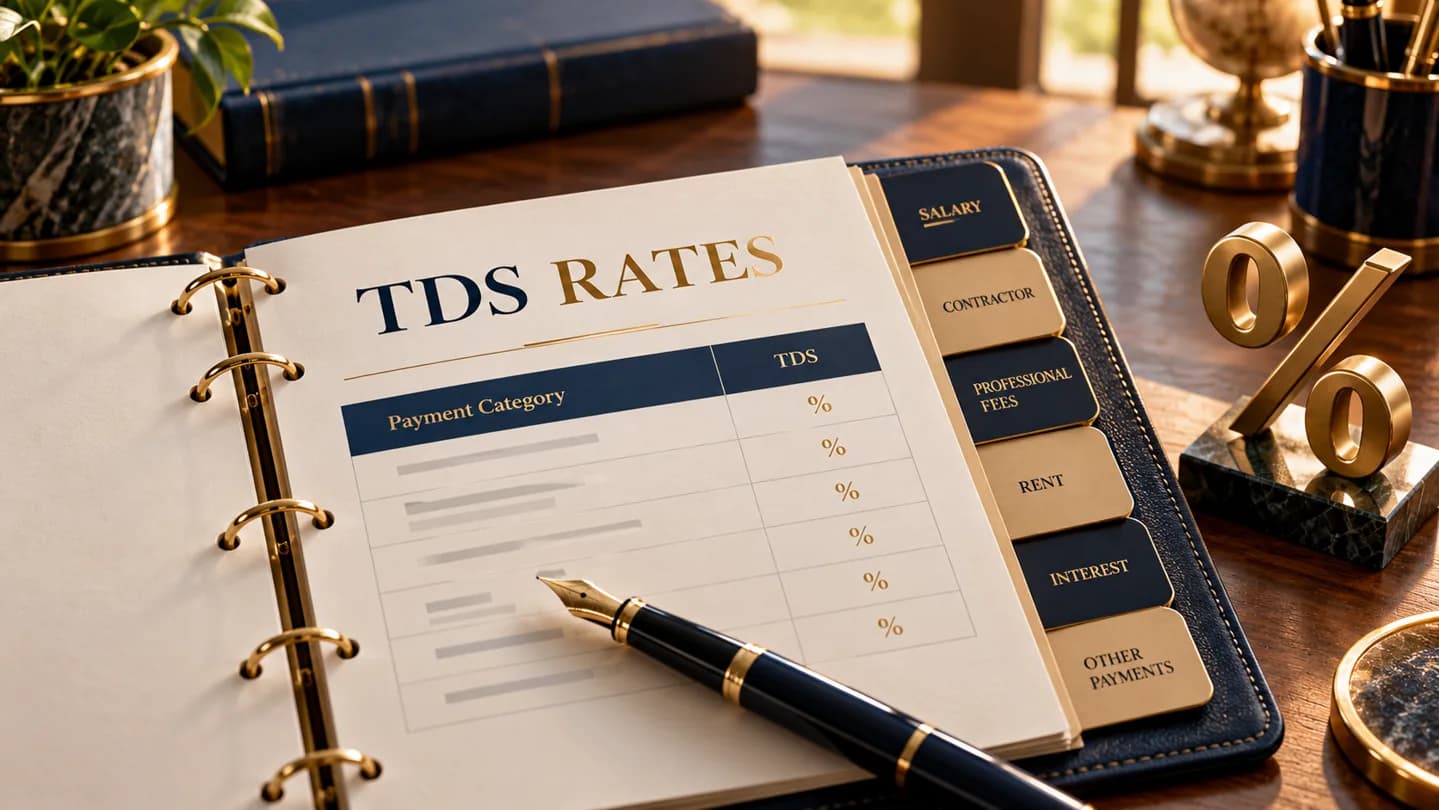
TDS is not one universal percentage. A business must identify the nature of payment, payee, threshold and applicable section before deducting tax.
Use the TDS Calculator for quick estimates after identifying the section.
Common TDS sections
The table below is a practical guide for common resident-payment situations as reviewed in July 2026. It is not a complete TDS chart.
| Payment | Common section | General rate context | Current threshold / caution |
|---|---|---|---|
| Salary | 192 | Average rate based on estimated salary income | No single payment threshold; deduct based on estimated taxable salary and rates in force. |
| Interest other than securities | 194A | Commonly 10%, subject to payee and exemption rules | For bank/co-operative bank/post-office time deposits, current threshold is generally Rs. 50,000, or Rs. 1,00,000 for senior citizens; other cases may have Rs. 10,000 or separate limits/exceptions. |
| Contractor payments | 194C | Commonly 1% for individual/HUF contractor and 2% for others | Current official threshold chart refers to no TDS if a single payment does not exceed Rs. 30,000 and aggregate payments do not exceed Rs. 1,00,000 during the financial year; transporter and other exceptions must be checked. |
| Commission/brokerage | 194H | Commonly 2% under current TDS-rate guidance, subject to conditions | Current official threshold chart refers to no TDS where payment does not exceed Rs. 20,000 during the financial year; exclusions such as specified telecom/franchisee cases should be checked. |
| Rent - plant/machinery | 194I | Commonly 2% | Current official threshold chart refers to monthly rent threshold language; verify whether Section 194-I or 194-IB applies based on payer status and facts. |
| Rent - land/building/furniture | 194I | Commonly 10% | Current official threshold chart refers to monthly rent threshold language; individual/HUF non-audit cases may fall under Section 194-IB instead. |
| Professional fees | 194J | Commonly 10% | Current threshold for professional fees/technical fees/royalty is Rs. 50,000 during the financial year; director's fees and personal-service exceptions require separate review. |
| Certain technical services | 194J | Commonly 2% for specified technical-service/call-centre/cinematographic royalty situations | Classification is important; do not apply 2% merely because the invoice says "technical". |
| Property purchase from resident | 194-IA | Commonly 1% | Applies to specified immovable-property transactions; current threshold chart refers to no TDS where consideration and stamp-duty value do not exceed Rs. 50,00,000. |
TDS rates and thresholds can change by Finance Act, notification, payment date and payee facts. If a transaction is material, review the current statutory provision and official rate/threshold chart before deduction.
Thresholds matter
Many TDS sections apply only after single-payment, monthly or aggregate thresholds. For example, contractor, rent, interest and professional-fee thresholds differ. Always review threshold aggregation for the full financial year and the correct effective period.
PAN not available
Section 206AA says that if the deductee does not furnish PAN, tax is generally deducted at the higher of:
- rate specified in the relevant provision;
- rate in force;
- 20%.
Some sections have special caps or modified PAN rules. Section 206AB, which earlier provided higher deduction for specified non-filers, has been omitted with effect from 1 April 2025. Check the exact section and effective period.
Lower/nil deduction certificate
If a valid certificate under the law applies, deduction may be at a lower rate or nil rate. Do not accept informal requests without proper documentation.
Resident vs non-resident
This guide focuses on common resident payments. Non-resident payments may involve Section 195, DTAA, withholding analysis, Form 15CA/CB and remittance rules.
Practical workflow for businesses
- Identify payment nature.
- Confirm payee type and residential status.
- Check PAN.
- Check threshold.
- Apply rate or certificate.
- Deduct at correct time.
- Deposit TDS and file return.
- Reconcile challan, return and certificate.
For broader compliance support, see Income Tax Services.
Official references
- Tax Deductor guidance, Income Tax Department
- Threshold limits under Income-tax Act, Income Tax Department
- TDS rates, Income Tax Department
- TDS on interest and professional/technical fees, Income Tax Department
- Section 206AA, Income Tax Department
- TDS on purchase of immovable property, Income Tax Department
This article is reviewed in July 2026. Verify current rates, thresholds and notifications before deducting tax.
FAQs
Frequently asked questions
Can one TDS rate apply to every payment?
No. TDS depends on the section, payment nature, payee, threshold, PAN, certificate and other facts.
What happens if PAN is not available?
Section 206AA may require deduction at the higher of the provision rate, rate in force or 20%, subject to section-specific rules.
Can lower TDS be deducted?
Lower or nil deduction may be possible only where a valid certificate or declaration applies under the law.
Practical tools
Related calculators
Use these indicative tools to explore the figures connected with this topic before discussing your specific circumstances.
Downloads & resources
Practical resources library
Checklists, reference sheets and downloadable guides for this topic will be added here as they are prepared and professionally reviewed.
Professional guidance
Need Professional Assistance?
Discuss your specific tax, compliance or business matter with Rajiv Malik & Associates. We will help you understand the practical next steps based on your circumstances.
Contact the firmContinue reading
Related articles